Blogs details
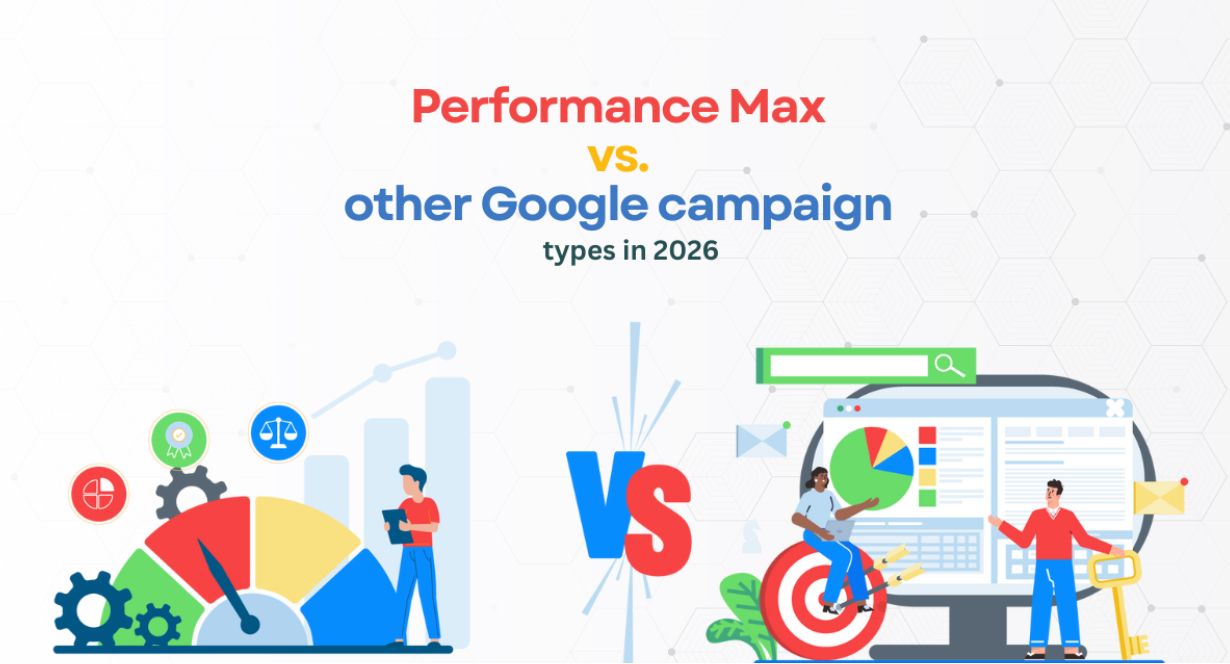
Performance Max vs. other Google campaign types in 2026
Performance Max: The All-In-One AI Engine
Imagine handing your entire advertising budget and a box of your best creative assets (pictures, videos, headlines) to a hyper-intelligent, 24/7 media buyer who is programmed only to hit your conversion goals. That's PMax.
PMax is a goal-based campaign that uses Google's AI to find your highest-value customers across all of Google's inventory: Search, Shopping, Display, YouTube, Gmail, Discover, and Maps. It’s designed for efficiency and scale, prioritizing your conversion value (sales, leads, etc.) above all else.
When to Use PMax (The Must-Haves)
When bottom-of-funnel efficiency and maximizing conversion volume over channels are your main aims, PMax sparkles.
You have to scale sales or leads rapidly: Should your company be prepared to manage a sudden rise in conversions and you're concentrating on Target Return on advertisement spend, or target cost per acquisition, is ROAS. PMax is the fastest way to get your ad in front of every potential buyer, wherever they are.
You Have Strong First-Party Data: The secret fuel for PMax is your own customer data (Customer Match lists). When you feed the AI your list of best customers, it uses that data as a "seed audience" to find new people who look and act exactly like them across the web.
PMax depends on a wide array of high-quality creative assets—text, images, videos—therefore you have a strong asset library. The AI regularly combines, matches, and tests these assets, adjusting the ad format to fit the channel (for example, a vertical video for YouTube Shorts, a responsive text advertisement for Search).
Retail/E-commerce with a Merchant Center Feed: PMax effectively replaced Smart Shopping, and when connected to a product feed, it becomes a powerful, automated engine for driving product sales.
The Titans: Where Control Still Rules
While PMax is an indispensable part of a modern strategy, it is not a replacement for campaigns where precision, control, and specific customer intent are non-negotiable.
1. Traditional Search Campaigns (The Intent Capturer)
Search campaigns are the original Google Ads workhorse. They are keyword-based and target users at the highest moment of commercial intent.
Why Search Still Matters (and Trumps PMax):
Brand Protection is All: You must dominate a search by a user for your precise company name, product line, or service. The only approach to ensure a high-quality, precisely regulated ad experience is running a focused Search campaign with exact match brand keywords.
Full Control Over Query/Message: You control every keyword and every single piece of ad copy. This is especially important for companies in extremely controlled sectors or those with specialized/technical goods needing exact messaging.
Aggressively bidding on a competitor's name calls for a focused Search campaign, which is the most straight and transparent method to carry out your strategy.
PMax Complements, Not Replaces: The core rule in 2026 is that a Search campaign with an exact-match keyword will always take priority over a PMax campaign. This allows you to use PMax for broad, high-volume keyword discovery while protecting your high-priority, high-intent terms with traditional Search.
2. Demand Gen Campaigns (The Mid-Funnel Builder)
Demand Gen is Google’s answer to social media advertising. It focuses on highly visual placements (YouTube, Discover, Gmail) and aims to create new demand—getting users interested before they start searching. Think of it as your primary tool for moving users from "discovery" to "consideration."
Why Demand Gen is Your Creative Lab:
Creative Testing with Clarity: Unlike PMax, Demand Gen offers superior reporting on creative assets and audience performance. You can clearly see which video or image is resonating best with a specific audience segment, turning it into your key testing ground.
Demand Gen provides more fine-grained, manual audience targeting control, which includes more effective usage of personalized Lookalike Audiences and interest-based targeting. This makes it perfect for product releases or brand awareness initiatives when you want to show off original creative to a certain population.
Focus on Visuals: If your product or service is highly visual (fashion, travel, luxury goods) and you need to leverage the full power of YouTube video or carousels, Demand Gen is often the superior tool because it is explicitly designed for high-engagement, visual content.
3. App Campaigns (The Mobile Specialist)
App campaigns are a specialized campaign type focused purely on driving mobile application installs, engagement, and registrations.
Singular Focus: If your only goal is app downloads or in-app actions, this campaign is the most efficient solution. It simplifies the process by prioritizing app-store interactions across the entire Google network.
The New Full-Funnel Strategy: Coexistence is Key
The savvy marketer in 2026 isn't asking which campaign type to use, but how to make them work together in a cohesive, full-funnel ecosystem.
Here is the modern strategic hierarchy:
Search (Traditional): The defensive layer. Capture immediate, high-intent demand and protect your brand terms.
Performance Max: The offensive layer. Scale conversions across the full web, using AI to find unexpected customers you didn't even know existed.
Demand Gen: The creative and educational layer. Create new demand higher up the funnel, warm up cold audiences with engaging visuals, and identify winning creative assets.
2026 Strategy Takeaway
The future of Google Ads is a two-part equation: AI + Human Expertise. The AI (PMax, Smart Bidding) handles the scale and the day-to-day optimization, while the human (you) manages the strategic inputs:
- The Data: Clean, first-party customer lists and accurate conversion values.
- The Creative: Diverse, high-quality images and videos.
- The Guardrails: Strategic use of Search for brand protection and negative keyword lists to prevent waste.
By strategically balancing the automation of PMax with the precision of Search and Demand Gen, you ensure you are capturing every single piece of demand at the exact moment it occurs, all while maximizing your profit margin.
Are your data inputs strong enough to let the AI win for you?
Quick FAQs
Q1: Should I pause my traditional Search campaigns and just run PMax?
No. That is one of the most common and costly mistakes. Your dedicated Search campaigns must remain active to protect your brand and highly specific, bottom-funnel exact-match keywords. PMax is designed to find new, incremental search terms that your manual Search campaign missed. They are partners: Search is your guard dog, and PMax is your scout.
Q2: How do I manage brand safety when PMax chooses the placements?
You can, and must, set Account-Level Negative Placements and Account-Level Negative Keyword Lists. While PMax limits your control, these account-wide tools act as safety rails. Use them to exclude low-quality websites or prevent your ads from showing for irrelevant search queries (like "free repair tips" if you sell a premium service).
Q3: What is the single most important input for a successful PMax campaign?
First-Party Data and Conversion Value. The quality of the data you feed the AI directly determines the quality of its performance.
First-Party Data: Use Customer Match lists to teach the AI what a profitable customer looks like.
Conversion Value: Ensure you are using dynamic conversion values (the actual dollar amount of a sale/lead) so the AI optimizes for profit, not just volume.
Q4: When should I choose Demand Gen over PMax?
Choose Demand Gen when creative control and audience testing are your main priorities.
If you need to know exactly which video is responsible for a lift in interest among a specific Lookalike Audience, use Demand Gen.
If you are running a large brand awareness campaign and need ads to look and feel exactly like social media content, use Demand Gen.
Once you find a winning creative in Demand Gen, you can move it to PMax to use it for mass conversion.
Q5: I have a limited budget. Which campaign type should I prioritize?
It depends on your goal:
If you need immediate, high-intent conversions (sales/leads today): Prioritize your Traditional Search campaign on your core, most profitable keywords.
If you need to scale efficiency (maximize ROAS) after a good start: Use Performance Max. Give the AI enough budget to hit its learning phase minimums.
Q6: Should I use the "New Customer Acquisition" goal in PMax?
Yes, always. This feature allows the AI to differentiate between an existing customer (who may convert easily) and a new one. You can set it to either bid higher for new customers or, even better, set it to only focus on new customers, ensuring your budget is spent on growth, not just existing loyalty.
Q7: What about the Display and Video campaigns? Are they completely dead?
They are not "dead," but they are largely consolidated into PMax and Demand Gen. PMax now accesses most of the Display and Video inventory automatically. The only reason to run a standalone Display or Video campaign in 2026 is for hyper-specific use cases, such as running a complex A/B test on a single audience segment, or strict frequency capping goals on a specific YouTube channel. For most businesses, the AI-driven scale and efficiency of PMax and Demand Gen make the manual campaign types redundant.